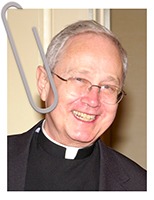


In effect he said the best thing we could do is … “Educate! Educate all your students to the needs right around them. Educate them to the social teaching of the church. Educate them to vote. As a bishop I may have some influence on drafting necessary legislation. But I need educated voters to support such legislation. It’s only way change will happen”
Sounds like the path for any major change!
“This is the layman’s hour”
Over 100 years ago Thomas Judge, CM, of the Eastern Province of the Congregation of the Mission said: “This is the layman’s hour”. In 1923 he was invited to address what we now know as Catholic Charities.
Listen to the following thoughts which were well in advance of his times. Think about how relevant these quotes from that brief landmark address are to today.
- “There is no school, no class so powerful to work good for the neighbor as the general body of the faithful or as we state it, the laity.”
- “The Bishops are on the eve of their annual meeting. Much of their conferring and resolving can be reduced to one word, the “laity.”
- “The hope of our generation lies with the faithful. All great movements come out of the laity, to them we look for our priests, for our consecrated and holy ones in every department of Catholic charity.”
- “The supreme question then is how to get from every workaday Catholic a sense of responsibility for his neighbor. It is necessary to make each of them realize that indeed he is his brother’s keeper.”
- “I then would like to leave this question before the assembly. “What can be done to inspire, to provoke, to lead the every-day Catholic into missionary work in the providence of his everyday life?”
Keep in mind that in his day the apostolate of the laity was a participation in the apostolate of the hierarchy which comes to them by way of hierarchical delegation.
Some 50 years later Vatican II broke new ground. It said that lay people have a right and duty to engage in the apostolate simply because they are members of the Church. Father Judge anticipated by decades its statement "The Christian vocation is, of its nature, a vocation to the apostolate" ["Apostolicam Actuositatem," No. 2].
Thomas Judge CM was a pioneer in fostering just such a concept. His recent authoritative biography sums up his life with the title “Every Catholic an Apostle”
He died Nov. 24, 1933 having spent most of his life fostering what was then called the “lay Apostolate.
Educate and empower lay people
St. Vincent understood the importance of educating and fostering lay people in the context of his day. We are just now rediscovering the forgotten truth that he educated and empowered the laity of his day. He organized charity and empowered the laity especially through his Confraternities of Charity but also the Daughters of Charity who he fought to keep out of the convents of the religious of his day.
These “confraternities” are being reborn today even if as yet somewhat "under the radar" . Also, anyone who is reading Pope Francis realizes how he is educating us in this spirit.
What needs to be done to awaken all Catholics to the implications of their Baptism?
Click below for an audio version of this Vincentian Mindwalk.
People have a moral responsibility to help out the lpoor
In the movie, “The American President” with Michael Douglas playing the President, he makes a speech near the end of the movie before the press corps that includes this excerpt:
“Then the symbol of your country can’t just be a flag; the symbol also has to be one of its citizens exercising his right to burn that flag in protest. Show me that, defend that, celebrate that in your classrooms. Then, you can stand up and sing about the ‘land of the free.’ I’ve known Bob Rumson for years, and I’ve been operating under the assumption that the reason Bob devotes so much time and energy to shouting at the rain was that he simply didn’t get it. Well, I was wrong. Bob’s problem isn’t that he doesn’t get it. Bob’s problem is that he can’t sell it! We have serious problems to solve, and we need serious people to solve them.”
That ability to “sell it” continues to be the problem with Thomas Judge and our present situation – we can’t seem to sell it to the laity what their role truly is. Jesus knew how to sell ideas, usually by example but also by stories. Maybe we need to be better story-tellers. (True stories, I should add.)